
Choosing the right plastic film thickness is one of the most critical — and most confusing — decisions in packaging. Too thin, and your product gets damaged in transit. Too thick, and you waste money on material you don’t need. This guide cuts through the confusion: we explain how film thickness is measured, provide a micron-to-gauge conversion chart, and give you exact thickness recommendations for every common packaging application.
What is a micron and how is film thickness measured?
A micron (also written as micrometre or µm) is one-thousandth of a millimetre. It is the standard unit used in India and most of the world to measure plastic film thickness. One micron = 0.001 mm.
In the packaging industry, you will encounter three units of measurement:
- Microns (µm) — the metric standard used in India, Europe, and Asia. This is what DP Udyog and most Indian manufacturers specify.
- Mils — used primarily in the United States. 1 mil = 25.4 microns.
- Gauge — an older imperial unit still used informally. 1 gauge = 0.254 microns (i.e., 100 gauge = 25.4 microns = 1 mil).
If you are sourcing packaging material in India, microns is the unit you need. If a supplier quotes in gauge or mils, use the conversion table below.
Micron to mil to gauge: conversion chart
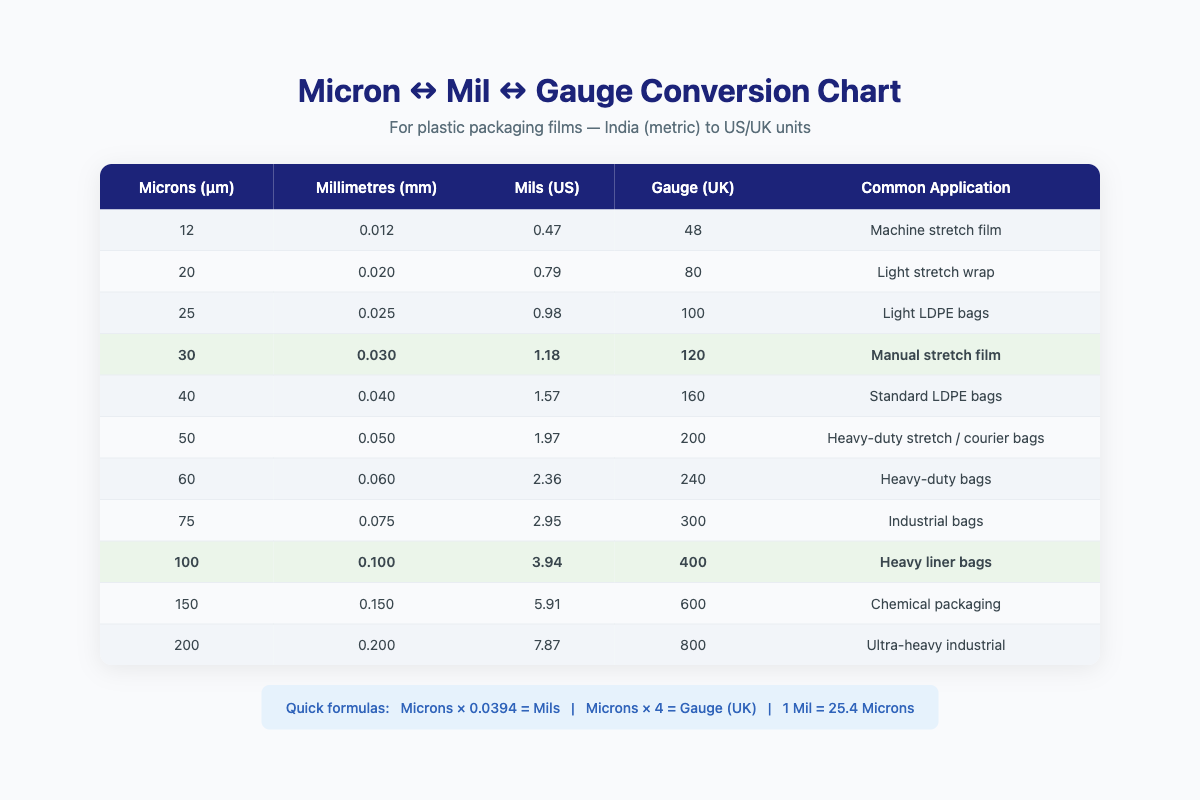
| Microns (µm) | Mils | Gauge | Typical use |
|---|---|---|---|
| 12 | 0.47 | 48 | Ultra-thin stretch film (machine grade) |
| 20 | 0.79 | 79 | Light-duty stretch wrap, thin liner bags |
| 23 | 0.91 | 91 | Standard machine-grade stretch film |
| 25 | 0.98 | 98 | Light-duty LDPE bags, standard liner bags |
| 30 | 1.18 | 118 | Manual stretch film, medium-duty bags |
| 40 | 1.57 | 157 | Standard LDPE bags, retail packaging |
| 50 | 1.97 | 197 | Heavy-duty stretch film, courier bags |
| 60 | 2.36 | 236 | Heavy-duty LDPE bags, garment covers |
| 75 | 2.95 | 295 | Industrial bags, dust covers |
| 100 | 3.94 | 394 | Heavy-duty liner bags, construction film |
| 150 | 5.91 | 591 | Extra-heavy-duty liners, chemical packaging |
| 200 | 7.87 | 787 | Ultra-heavy-duty industrial liners |
Quick formula: Microns × 0.0394 = Mils. Microns × 3.937 = Gauge.
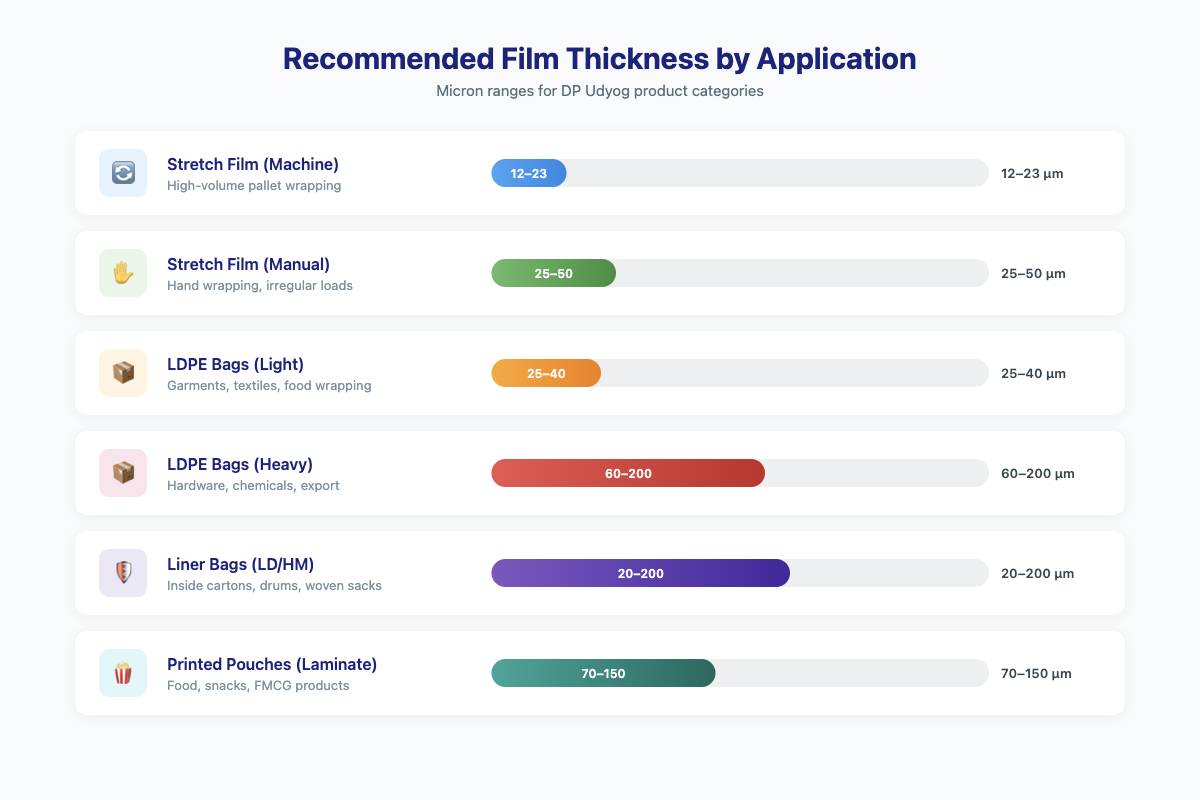
Recommended film thickness by application
Stretch film (pallet wrapping)
Stretch films are measured in LLDPE and are available from 12 to 50 microns. The right thickness depends on whether you are using manual or machine application and how heavy your loads are:
| Thickness | Application | Best for |
|---|---|---|
| 12–17 microns | Machine-grade (high pre-stretch) | High-volume automated wrapping; lighter loads up to 500 kg |
| 20–23 microns | Standard machine-grade | Mixed pallets, medium loads (500–1000 kg) |
| 25–30 microns | Manual wrapping | Hand application; irregular or sharp-edged loads |
| 35–50 microns | Heavy-duty manual | Very heavy or unstable loads; sharp corners (e.g., machinery, metal parts) |
Pro tip: Machine-grade film at 17 microns with 200–300% pre-stretch can outperform a 30-micron hand wrap on load stability — while using less material per pallet. If you are wrapping more than 15–20 pallets per day, the ROI on a machine wrapper is typically under 6 months.
LDPE bags
LDPE plastic bags range from 25 to 200 microns. The right choice depends on what you are packaging and how it will be handled:
| Thickness | Best for |
|---|---|
| 25–40 microns | Lightweight items: garments, textiles, documents, food-grade wrapping (bakery, dry snacks) |
| 40–60 microns | General-purpose packaging: retail bags, e-commerce mailers, product covers |
| 60–100 microns | Heavy-duty use: hardware components, auto parts, chemical powders, bulk food packaging |
| 100–200 microns | Industrial applications: heavy components, corrosive materials, export packaging requiring maximum puncture resistance |
For a detailed material comparison, see our guide on LDPE vs PP bags.
Liner bags (LD and HM)
LD liner bags and HM liner bags are used inside cartons, drums, and woven sacks to provide an additional moisture and contamination barrier. Thickness recommendations:
| Thickness | Best for |
|---|---|
| 20–40 microns | Light powders, grains, textiles — standard inner lining for woven sacks |
| 40–75 microns | Chemicals, fertilisers, hygroscopic powders — where moisture ingress is a concern |
| 75–150 microns | Pharmaceuticals, food ingredients, aggressive chemicals — maximum barrier and puncture resistance |
| 150–200 microns | Heavy industrial materials, sharp-edged goods, export packaging under extreme handling conditions |
LD vs HM: LD liners (LDPE) are softer, more flexible, and offer better clarity and sealability — ideal for food and pharma. HM liners (HM-HDPE) are stiffer and stronger at the same thickness, making them better for heavy loads and rough handling. For the same level of puncture resistance, HM bags can be 20–30% thinner than LD bags.
Printed pouches and food packaging
For custom printed pouches used in food, snacks, spices, and FMCG products, multi-layer laminates are typically specified by total structure thickness rather than a single film layer. Common structures range from 70 to 150 microns total, depending on barrier requirements (moisture, oxygen, aroma), shelf life targets, and whether the pouch is for dry or moist products.
How thickness affects performance and cost
Understanding the trade-offs helps you avoid both under-specifying (risking product damage) and over-specifying (wasting money):
| Property | Effect of increasing thickness |
|---|---|
| Puncture resistance | Increases significantly — a 50-micron film has roughly 2× the puncture resistance of a 25-micron film of the same material |
| Tear resistance | Increases proportionally with thickness |
| Clarity / transparency | Generally decreases slightly at higher thicknesses; thinner films appear clearer |
| Flexibility | Decreases — thicker films are stiffer and harder to hand-wrap |
| Material cost | Directly proportional — doubling thickness roughly doubles material cost per bag/roll |
| Weight per unit | Increases proportionally — impacts freight and handling costs |
| Moisture barrier | Improves with thickness for the same material |
| Heat seal strength | Thicker films require more sealing time/temperature but produce stronger seals |
5 common mistakes when specifying film thickness
- Specifying by what you used before, not by what you need. If your product, packaging line, or supply chain has changed, your thickness requirement may have too. Re-evaluate when you change suppliers.
- Confusing gauge with microns. A “100 gauge” film is only 25.4 microns — not 100 microns. This mix-up can leave you with film 4× thinner than intended.
- Ignoring pre-stretch in stretch film. A high-quality 17-micron film with 250% pre-stretch delivers more effective layers and better load holding than a cheap 30-micron film with no stretch. Performance is not just thickness — it is also material quality and application method.
- Over-specifying “just to be safe.” If your product is garments or textiles, a 100-micron bag is wasted material. A 40-micron bag provides more than enough protection and saves 60% on material cost per unit.
- Not testing with actual products. Run a drop test and transit simulation with your actual product before finalising a thickness. A sample roll is far cheaper than damaged goods or customer complaints.
How to choose: a simple decision framework
Ask these four questions to arrive at the right thickness:
- What are you packaging? — Lightweight and non-fragile (textiles, paper) → lower microns. Heavy, sharp, or moisture-sensitive → higher microns.
- How will it be handled? — Manual handling with care → lower microns. Rough transit, stacking, forklift movement → higher microns.
- What is the material? — HM-HDPE is stronger per micron than LDPE. LLDPE stretch film performs better per micron than standard LDPE film. Material grade matters as much as thickness.
- What is your cost target? — Calculate cost per unit (bag/roll/metre) at different thicknesses. Often, moving one grade up in material quality at a slightly lower thickness delivers better performance at equal or lower cost than simply increasing thickness of a cheaper material.
When in doubt, ask your manufacturer for sample rolls at 2–3 thickness options and run a practical test. At DP Udyog, we regularly help customers trial different micron specs before committing to a bulk order.
DP Udyog film thickness options
We manufacture across the full thickness range to match every application:
| Product | Material | Thickness range |
|---|---|---|
| Stretch Films | LLDPE (100% virgin) | 12–50 microns |
| LDPE Plastic Bags | LDPE | 25–200 microns |
| LD Liner Bags | LDPE (virgin grade) | 25–200 microns |
| HM Liner Bags | HM-HDPE | 20–200 microns |
| Custom Printed Pouches | Multi-layer laminate | 70–150 microns (total) |
All products are available in custom thicknesses within these ranges. We offer sample rolls for testing before bulk orders, and our team can recommend the optimal thickness for your specific product and handling conditions.
Explore our full product range or get in touch with our team to discuss your requirements.
Frequently Asked Questions
What does micron mean in plastic bags?
A micron (µm) is one-thousandth of a millimetre. In plastic bags and films, it measures the wall thickness of the material. Higher microns mean a thicker, stronger bag. For example, a 25-micron LDPE bag is suitable for lightweight items, while a 100-micron bag is needed for heavy or sharp objects.
How do I convert gauge to microns?
Divide the gauge number by 3.937 to get microns. For example, 200 gauge ÷ 3.937 = approximately 50.8 microns. Alternatively, multiply microns by 3.937 to convert to gauge. A quick reference: 100 gauge = 25.4 microns = 1 mil.
What thickness of stretch film should I use for pallet wrapping?
For machine wrapping, 12–23 microns is standard (the machine pre-stretches the film for added strength). For manual hand wrapping, 25–35 microns is recommended. Heavy or unstable loads may require 35–50 microns. Higher pre-stretch capability means you can use thinner film without sacrificing load stability.
What is the difference between LDPE and HM-HDPE at the same micron thickness?
HM-HDPE (High Molecular High-Density Polyethylene) is stiffer and stronger than LDPE at the same thickness. It offers superior puncture and tear resistance, making it better for heavy-duty applications. LDPE is softer, more flexible, and offers better clarity and heat-sealability — ideal for food packaging and retail display.
Does thicker film always mean better protection?
Not necessarily. Material grade, manufacturing quality, and application method all affect performance. A high-quality 23-micron LLDPE stretch film with proper pre-stretch can outperform a low-quality 35-micron film. Similarly, HM-HDPE bags at 60 microns can match LDPE bags at 80–100 microns in puncture resistance. Always consider total performance, not just thickness.
What is the minimum thickness for food-grade packaging?
There is no single minimum — it depends on the food product, shelf life requirements, and regulatory standards. However, most food-grade LDPE bags start at 25–40 microns for dry goods and go up to 60–100 microns for heavier or moisture-sensitive products. The material must be food-safe (virgin grade, FSSAI compliant) regardless of thickness.